
For most of the year, Bangkok’s Chao Phraya is a working river: ferries dart between banks, long-tail boats kick up spray and express boats nose into crowded piers. But from August to October 2026, something extraordinary appears among the everyday traffic.
First, you notice flashes of gold upstream.
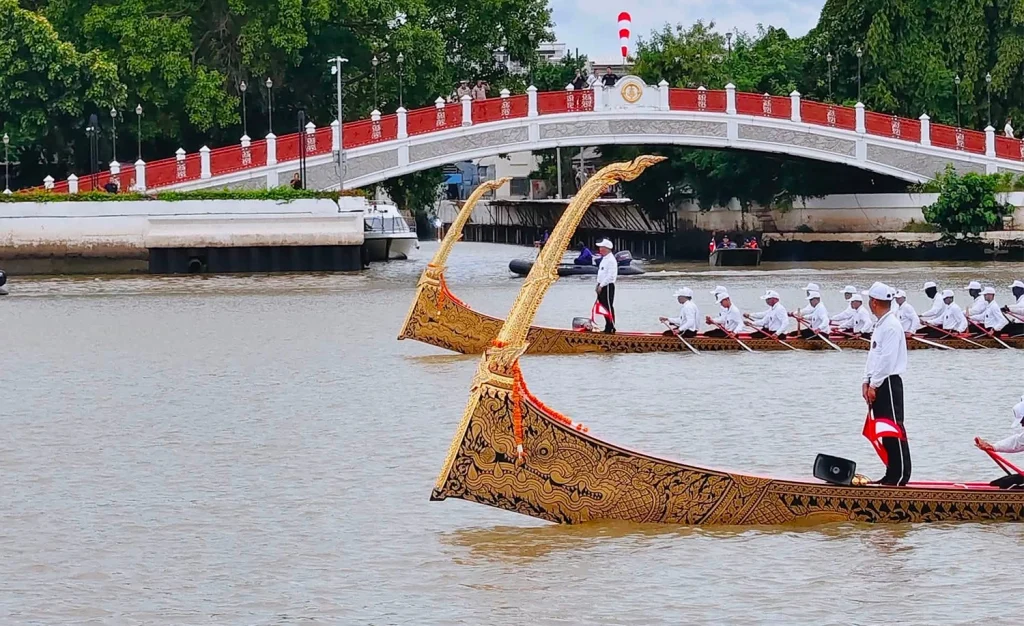
Then come the long, slender boats, ornate prows catching the tropical light. Hundreds of oars rise and fall almost as one. More vessels follow until much of the river seems occupied by paddlers, gilded hulls and mythical creatures.
This is the Royal Barge Procession in rehearsal, preparing for the Royal Kathin Ceremony on 6 November. And for travellers, it offers a rare opportunity not only to witness one of Thailand’s grandest ceremonial traditions, but to see Bangkok the way it was originally meant to be seen: from the water.
A city built around a river
Before roads took over, the Chao Phraya and its network of canals were Bangkok’s main transport system. Temples, palaces, markets and communities faced the water because this was the city’s front door.
That relationship is still visible today.
In rainy season, brown water rushes past ferry piers and concrete embankments. Commuter boats shuttle between Bangkok and Thonburi, while long-tail boats carrying visitors weave through the current. Beyond the banks rise temple roofs, apartment towers, old wooden houses and glittering spires.
Following a Royal Barge rehearsal puts these fragments back together.
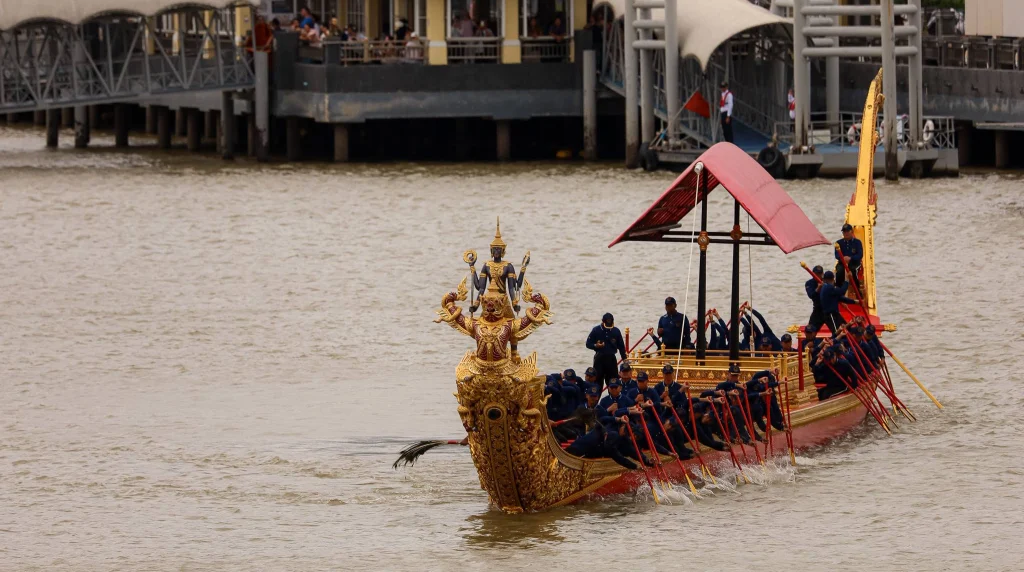
The route begins upstream at Wasukri Pier, near the Royal Barges National Museum, before heading south past Phra Sumen Fort and beneath Somdet Phra Pinklao Bridge. From here, the fleet passes Siriraj Hospital and the Grand Palace before continuing towards the Royal Thai Navy Auditorium and Wat Arun.
It’s effectively a floating journey through some of Bangkok’s oldest neighbourhoods.
Around Phra Sumen, remnants of the fortified city survive alongside temples and old riverside communities. Beyond Pinklao Bridge, the Grand Palace appears on the eastern bank. Across the river lies Thonburi, capital of Siam before Bangkok was established opposite it in 1782.
Ferries still cross between the two every few minutes, linking communities separated by just a few hundred metres of water.
On rehearsal days, however, this normally hectic stretch of river belongs to the royal fleet.
Fifty-two barges, 2200 paddlers
The scale becomes apparent only when the entire formation approaches.
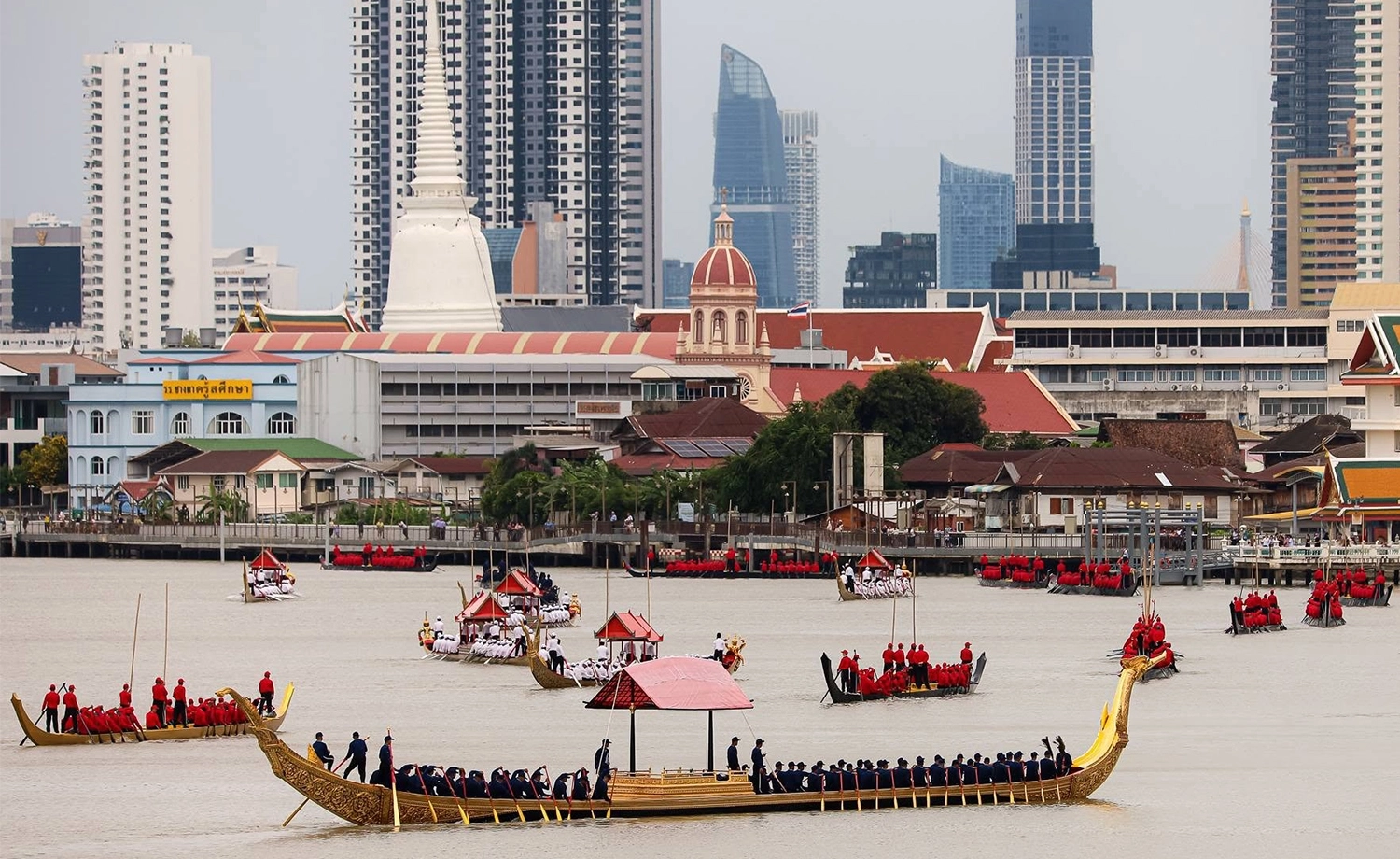
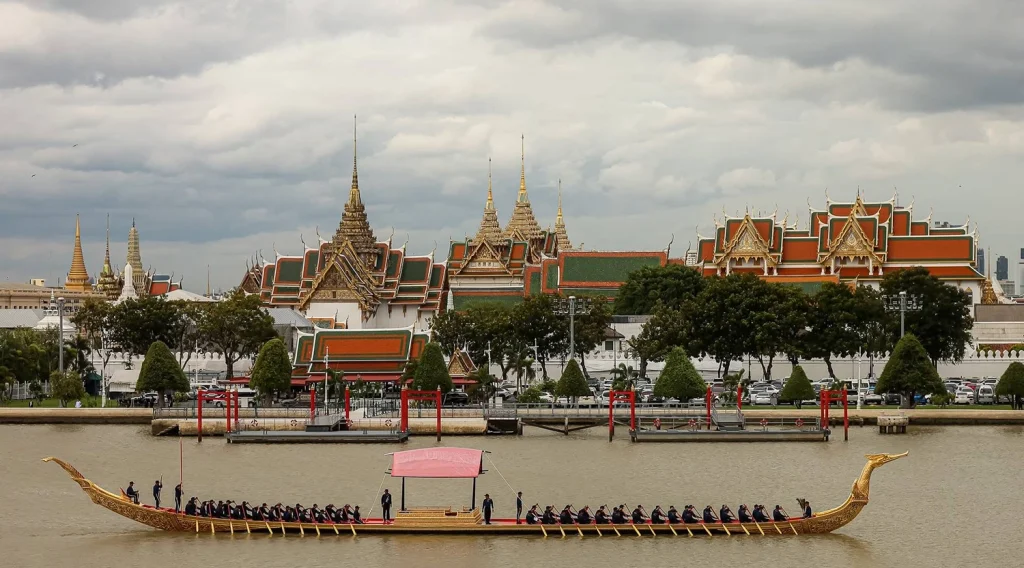
The procession comprises 52 royal barges crewed by around 2200 Royal Thai Navy personnel. Arranged in five columns and three lines, the fleet stretches roughly 1280m along the river and 90m across it.
Yet from the riverbank, sheer size quickly gives way to something more mesmerising: precision.
Rows of paddlers move together, oars rising almost simultaneously before dipping back into the Chao Phraya. Narrow hulls hold their positions against the current as bridges, temples and high-rises slide past behind them.
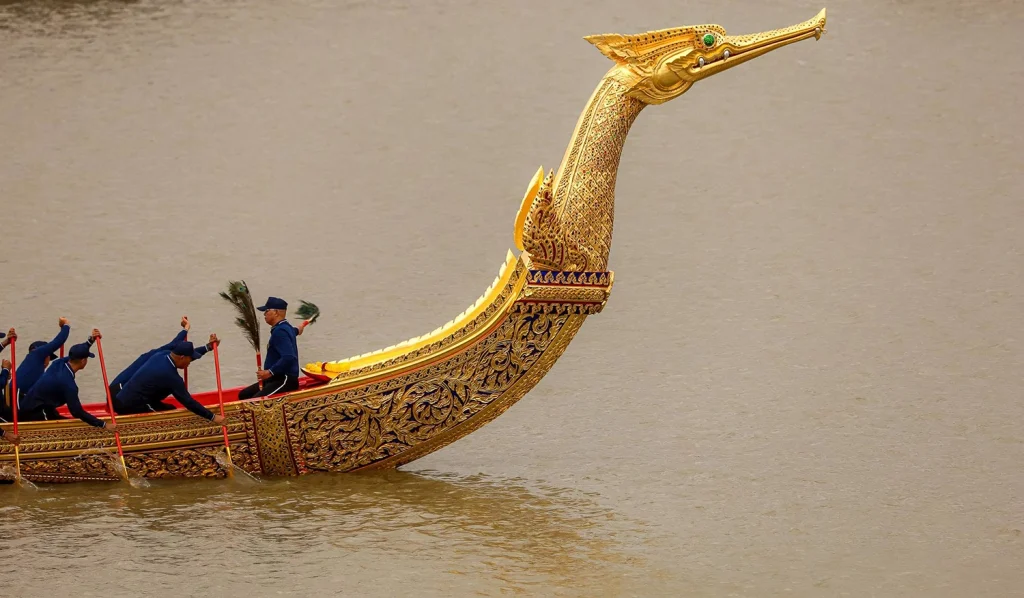
Among the 52 vessels, one is impossible to miss.
The Suphannahong Royal Barge stretches low across the water before rising dramatically into the gilded head and long neck of a swan. The present vessel dates from the early 20th century, although the tradition behind it reaches back to the Ayutthaya period. In 1992, Suphannahong received the World Ship Trust Maritime Heritage Award.
You can admire the craftsmanship of Thailand’s royal barges inside the Royal Barges National Museum. But seeing them on the Chao Phraya is an entirely different experience.
Here, propelled by hundreds of paddlers and surrounded by the full fleet, museum pieces become working vessels again.
The best views are all about the backdrop
Watching a rehearsal also provides an excellent excuse to slow down and explore riverside Bangkok.
Instead of racing between the Grand Palace and Wat Arun, make the river part of the day: ride a ferry, wander around a pier or settle into a riverside cafe while waiting for the fleet.
Where you watch matters.
Around Tha Tien and Nagaraphirom Park on the Bangkok side, the barges can be seen crossing the Chao Phraya with Wat Arun’s porcelain-covered prang rising behind them — one of the procession’s classic views.
Cross to the Thonburi bank around Siriraj or Wat Rakhang and the perspective reverses, placing the barges against the Grand Palace and Bangkok’s historic skyline.
Farther upstream, the Phra Sumen and Pinklao areas offer wider views, making them better places to appreciate the sheer scale and geometry of the 52-barge formation.
The procession also reveals why Bangkok’s major riverside landmarks are where they are. Temple compounds face the water because the Chao Phraya was once their principal approach. Ferries continue to connect neighbourhoods on opposite banks, while markets, restaurants and homes still cluster around piers.
For a few hours, Bangkok begins to make sense as a river city again.
ARTS & CULTURE
Bangkok’s Hidden Temple
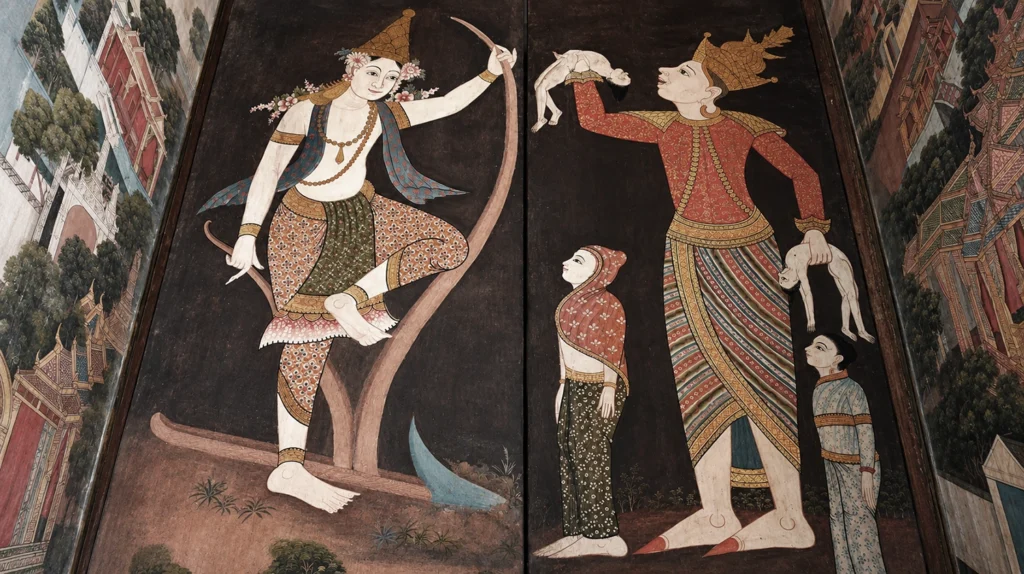
Hidden within Bangkok’s former Front Palace, Wat Bowon Sathan Sutthawat — better known as Wat Phra Kaew Wang Na — is one of the city’s lesser-seen royal temples, revealing a remarkable painted world of Buddhas, Hindu gods and celestial beings shaped by centuries of religious and artistic exchange.
>> Read more
When to see the Royal Barges
Rehearsals are scheduled for 17, 20 and 27 August; 3, 8, 17 and 23 September; and 2, 8 and 15 October 2026. Full-dress rehearsals take place on 21 and 28 October, offering the most complete preview before the Royal Kathin Ceremony on 6 November.
Spectators can watch from both banks between Krung Thon Bridge and Wat Arun. Arrive early for the best riverfront positions, particularly around Tha Tien and the Grand Palace area.
Eventually, the fleet reaches Wat Arun, its great central prang rising above the western bank.
It’s a fitting destination. For all the royal splendour of the procession, the journey culminates not at a palace but at a Buddhist temple, where the Royal Kathin Ceremony takes place.
Against ferries, bridges and Bangkok’s modern skyline, the barges look very different from the vessels resting quietly inside the museum.
On the Chao Phraya, powered by 2200 paddlers, they come alive — carrying a centuries-old tradition through the heart of a city that is still, unmistakably, written in water.