

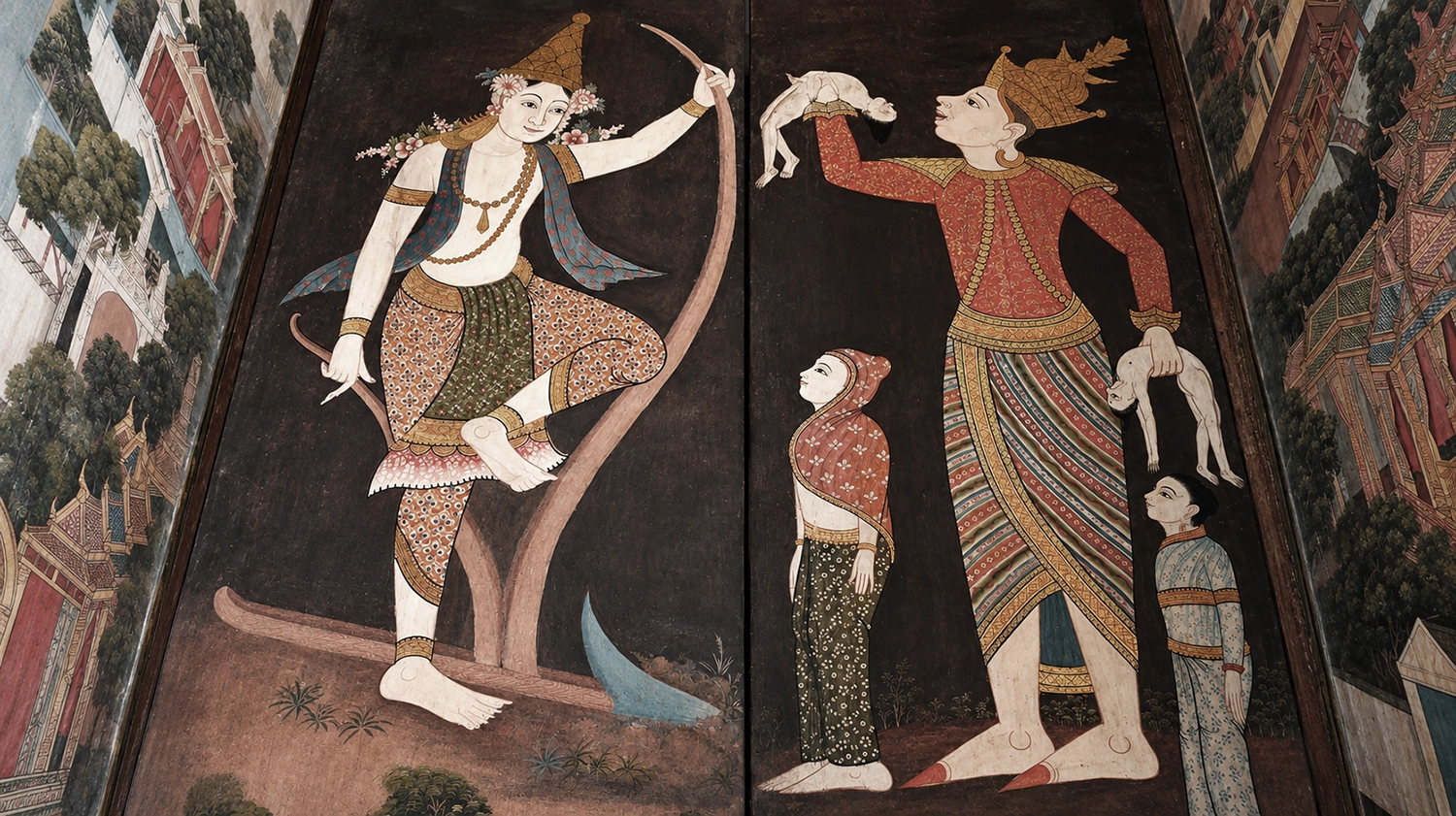
Bangkok is not short of spectacular temples. But every so often, one that usually keeps its doors closed gives visitors a reason to look again.
Hidden within the grounds of the former Front Palace, Wat Bowon Sathan Sutthawat — better known as Wat Phra Kaew Wang Na — is open to the public until Sept. 20. For visitors and Bangkok residents alike, it is a rare opportunity to step inside one of the city’s lesser-seen royal temples and enter a painted world of Buddhas, Hindu gods, celestial beings and stories shaped by centuries of religious and artistic exchange.
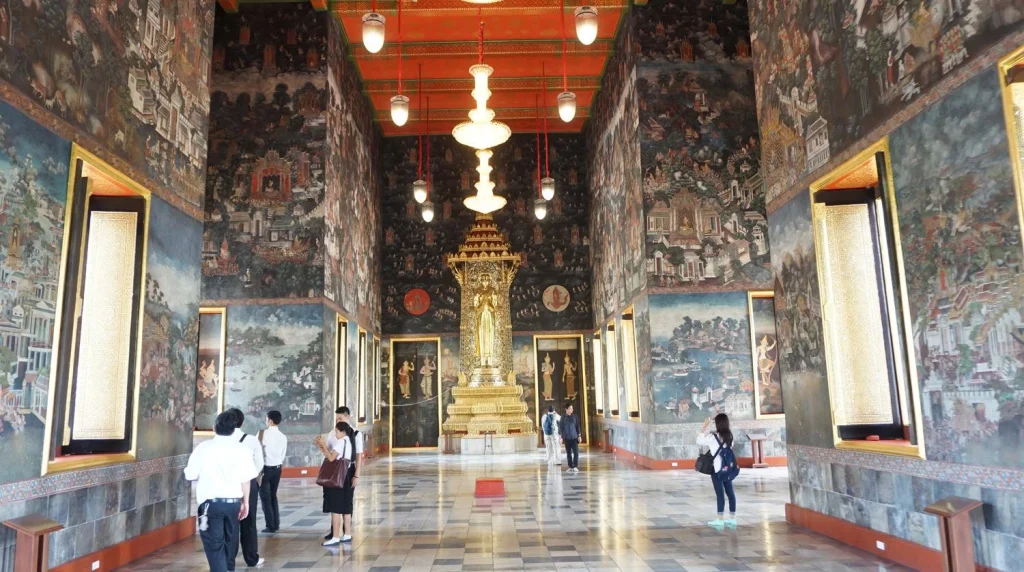
Once inside, don’t rush.
At first, the decoration can be difficult to take in. Celestial beings hover high above. Rows of Buddhas occupy another register. Narrative scenes unfold across the lower walls, while Hindu gods appear on the window shutters. Against the western wall stands a monumental Buddha, both hands raised in the distinctive Pang Ham Samut, or “Calming the Ocean,” posture.
Stay a little longer, though, and the apparent jumble begins to reveal an order.
Bangkok’s Other Wat Phra Kaew
The temple’s nickname offers the first clue to its importance.
Wang Na means Front Palace, once the residence of the kingdom’s second-ranking ruler. Just as the Grand Palace had Wat Phra Si Rattana Satsadaram — the famous Wat Phra Kaew — the Front Palace had its own royal sanctuary. Like its better-known counterpart, Wat Bowon Sathan Sutthawat has no resident monks.
The site was once occupied by Wat Luang Chi, a temple dating from the reign of Rama I. After it fell into disrepair, it was demolished during the reign of Rama II, and the grounds became a garden where rabbits were kept.
The temple visitors see today was commissioned by Prince Maha Sakdiphonlasep, ruler of the Front Palace during the reign of Rama III. He died before it was completed, and work later continued under King Pinklao and King Mongkut during the reign of Rama IV.
The result is an imposing cruciform ordination hall set on a three-tiered platform. But the reason to linger is inside.
How to Read a Temple
Rather than trying to decipher every scene at once, find a place near the center of the hall and look up.
The interior unfolds in layers.
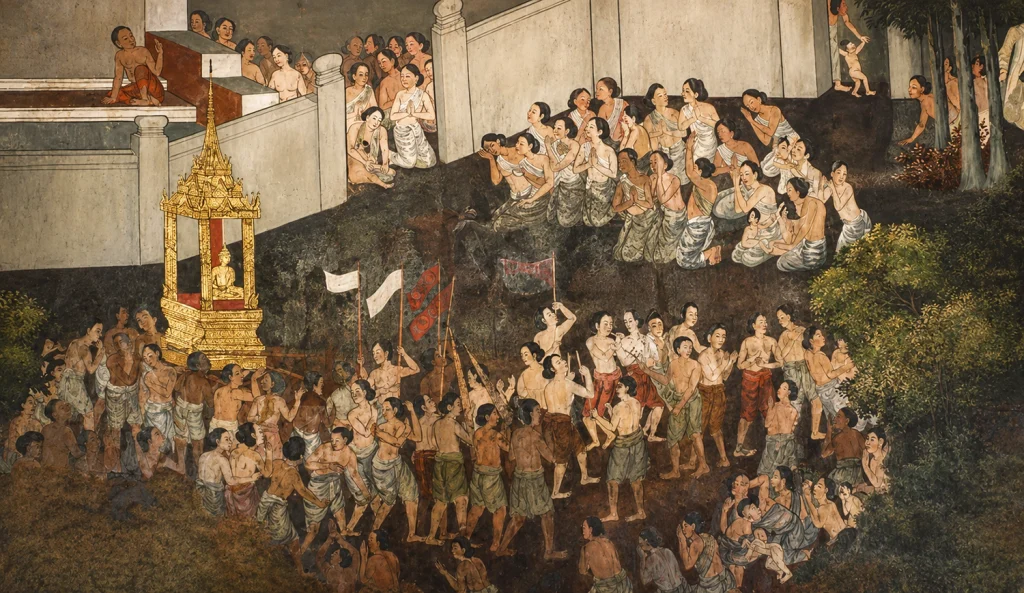
Celestial deities occupy the upper walls. The 28 Buddhas of the Past appear above the doors and windows. Below them runs the story of Phra Buddha Sihing, the revered Buddha image once intended for the temple. The doors and window shutters introduce another realm, populated by divine manifestations and guardian deities.
Move slowly around the hall and the decoration begins to resemble a map of a sacred universe. Figures that first appear purely ornamental start to acquire relationships: one deity leads to another; a weapon suggests an identity; an animal offers a clue; a scene points toward a story.
That act of looking is part of what makes Wat Phra Kaew Wang Na so absorbing.
Hindu Gods in a Buddhist Sanctuary
Turn your attention to the shutters and you will find figures that seem, at first, to belong to another religious world.
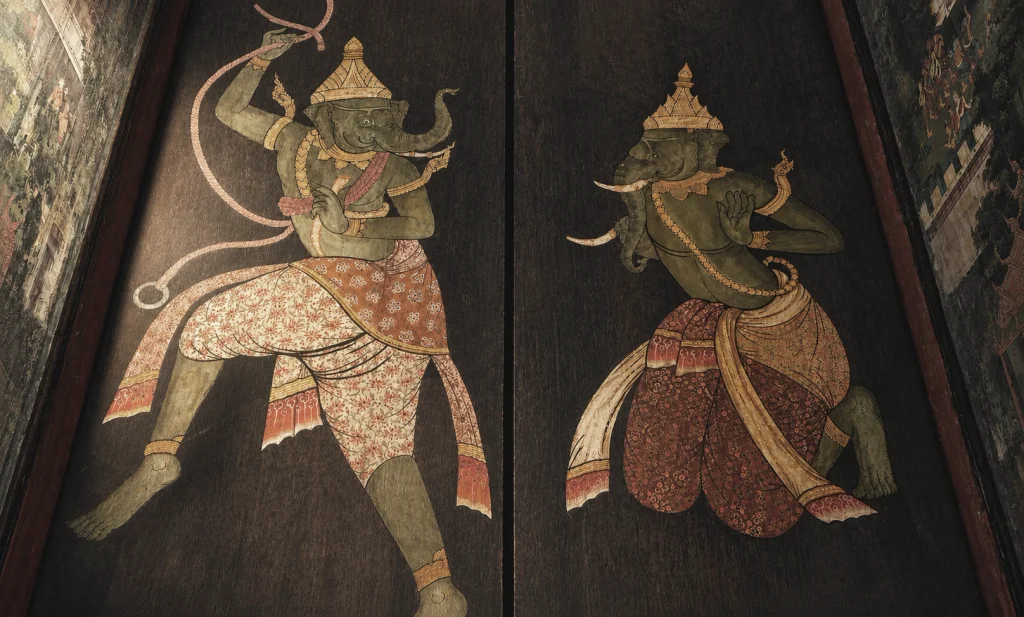
The Fine Arts Department identifies among them Hindu deities in various manifestations, Ganesha, the Ten Incarnations of Narayana and supernatural beings drawn from Indian traditions, including the Mahabharata and Puranic literature.
But this is not a straightforward illustrated guide to Hindu mythology.
The painters were not simply reproducing Indian religious art. The stories had traveled, changing as they passed through Thai literature, religious belief and court culture. The Thai tradition of Narai Sip Pang, or the Ten Incarnations of Narayana, developed interpretations of its own, meaning that attempts to match every figure neatly with the standard Indian Dashavatara can quickly become complicated.
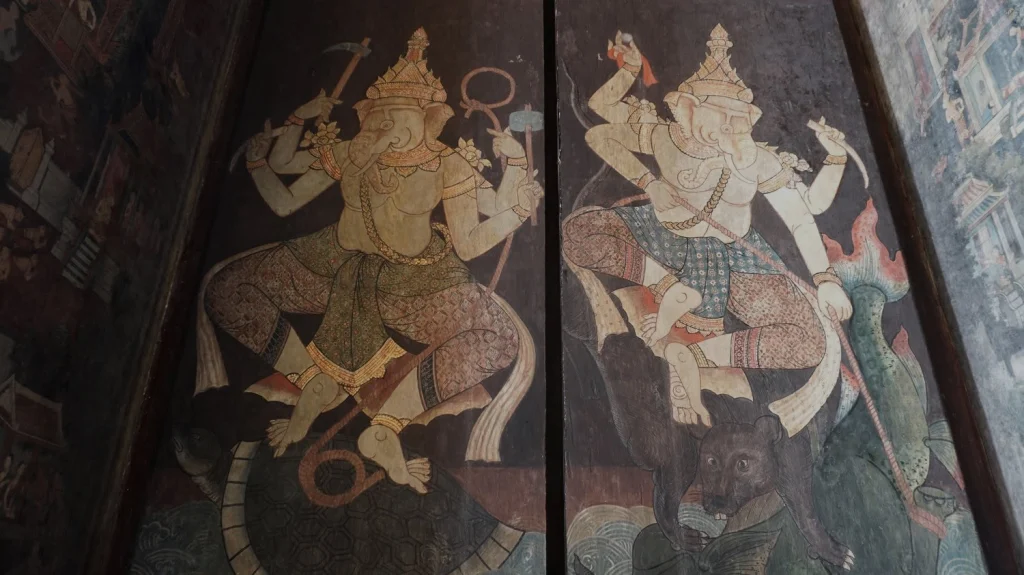
Instead, look for clues.
Multiple arms, unusual weapons and animal companions can help. Garuda may point toward Vishnu, Nandi the bull toward Shiva, and a mouse toward Ganesha. At other times, the clue lies in what the figure is doing — defeating a demon, perhaps, or reenacting an episode from mythology.
You do not need to identify them all. The uncertainty is part of the pleasure.
Sun and Moon
For an easier challenge, head toward the western wall.
On the inner window shutters beside the principal Buddha image are two figures whose identities are documented: Surya, the sun god, and Chandra, the moon god. Positioned on either side of the Buddha, the two celestial bodies become part of the ordered universe surrounding him.
Ganesha should also be relatively easy to recognize; the elephant head is a useful clue.
But look beyond the obvious. Count his arms. Examine what he carries. Search for his mouse vehicle, then study his clothing and ornaments.
The paintings begin to reveal something more interesting than simply who is who. These are Indian gods translated into the visual language of the Siamese court.
When the Gods Guard the Windows
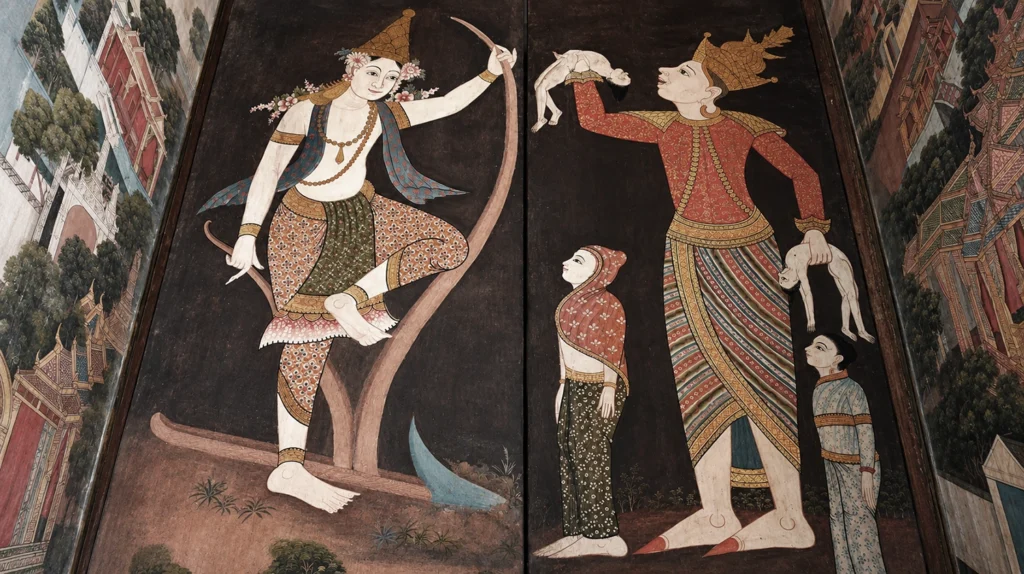
One of the temple’s most intriguing details is also easy to overlook: The figures were not painted on the shutters merely as decoration.
These divine manifestations, known as thewapang, function as guardians of the sanctuary. When the shutters are closed, they occupy the threshold between the sacred interior and the world outside.
The windows themselves have two identities.
From outside, they are covered in gilded woodcarving, mirror inlay, vegetal patterns and ceramic decoration. Inside, they become painted surfaces for gods and cosmology.
Open the shutters and the divine figures effectively disappear against the walls.
Close them, and the gods return.
It is a subtle piece of theatricality in a building filled with grand religious imagery, and perhaps one of the details most likely to stay with you after you leave.
NATURE
Grace in the Marsh
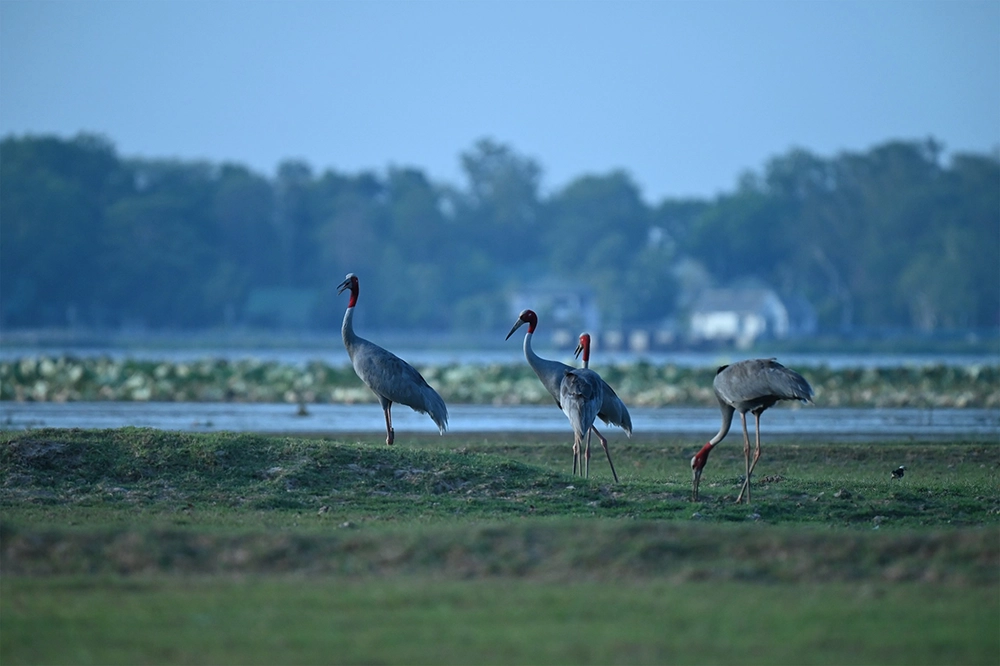
Just 20 minutes south of Buri Ram’s bustling town centre, the landscape opens into the wetlands and rice paddies of Huai Chorakhe Mak Reservoir. Here, Thailand’s rare sarus cranes have returned to the wild, stalking gracefully through shallow marshes and farmland in a landscape where conservation and local livelihoods have learned to coexist.
>> Read more
Before You Leave
The architecture deserves attention, too. The cruciform ordination hall rises from a three-tiered platform beneath a roof of colored tiles. Its cho fa roof finials take the distinctive pak pla, or “fish-mouth,” form, rather than the pak nok, or “bird-mouth,” style associated with the Grand Palace.
Then make one final circuit of the interior.
Bangkok’s abundance of temples can encourage a checklist approach: Buddha image, mural, gilded doorway, photograph, next stop. Wat Phra Kaew Wang Na rewards something slower.
Look long enough and connections begin to emerge — between Buddhism and Hindu mythology, India and Siam, literature and painting, architecture and cosmology.
Because the temple is not routinely accessible, there is also the simple pleasure of being somewhere that usually remains out of sight.
For a few more weeks, this secluded corner of Bangkok’s royal past is open. Take your time with it.
If You Go
Wat Bowon Sathan Sutthawat (Wat Phra Kaew Wang Na) is a short walk from the National Museum, reached via Na Phra That and Rachini alleys. The temple is open daily through Sept. 20, 2026, from 9 a.m. to 4 p.m. Admission is free, and no advance registration or reservation is required. On Wednesdays, Thursdays, Saturdays and Sundays, guided tours are offered at 9:30 a.m., 11 a.m., 1 p.m. and 3 p.m.
Allow at least an hour. Spend some of it simply studying the shutters. Knowing the identity of every deity is not necessary; learning to look for the clues is part of the experience.





[…] >> Read more […]
[…] >> Read more […]
[…] >> Read more […]
[…] >> Read more […]
[…] >> Read more […]
[…] >> Read more […]
Comments are closed.