

An hour beyond the last petrol station in Chaiyaphum Province, the road begins to climb. Villages thin out, trees press closer and the air through the open window grows noticeably cooler. The bends come one after another as the road winds higher into the forested mountains of northeastern Thailand.
Then, inside Phu Khieo Wildlife Sanctuary, the trees suddenly fall away.
Ahead lies Thung Kamang: a broad sweep of grassland enclosed by evergreen forest and low, wooded hills. After kilometres of dense tropical greenery, its openness comes as a surprise. It looks almost like a highland savanna, the grasses rippling in the breeze beneath an enormous sky.
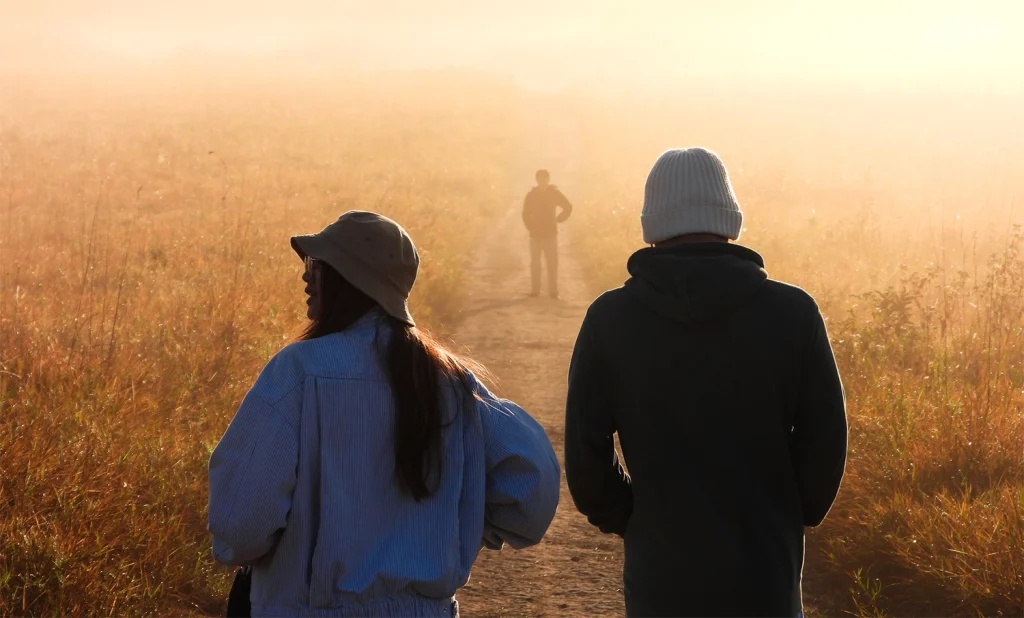
Come early enough and mist lies across the meadow, pooling in hollows and drifting between the trees.
And somewhere in that whiteness, the deer are beginning to move.
Into the meadow
Thung Kamang covers around eight square kilometres, forming a natural basin among the surrounding hills. Seen from higher ground, the geography becomes easier to read: gently undulating grassland threaded with small streams and enclosed almost completely by forest.
During the rainy season and the cooler months, fog can linger well into the morning. Trees appear and disappear as the mist moves, while dew clings to the grass and spider webs.
There is little to do but wait.
A movement at the forest edge might turn out to be nothing more than a branch shifting in the breeze. A brown shape in the grass becomes a stump. Then another shape moves — definitely this time — and a deer steps cautiously into the open.
Another follows.
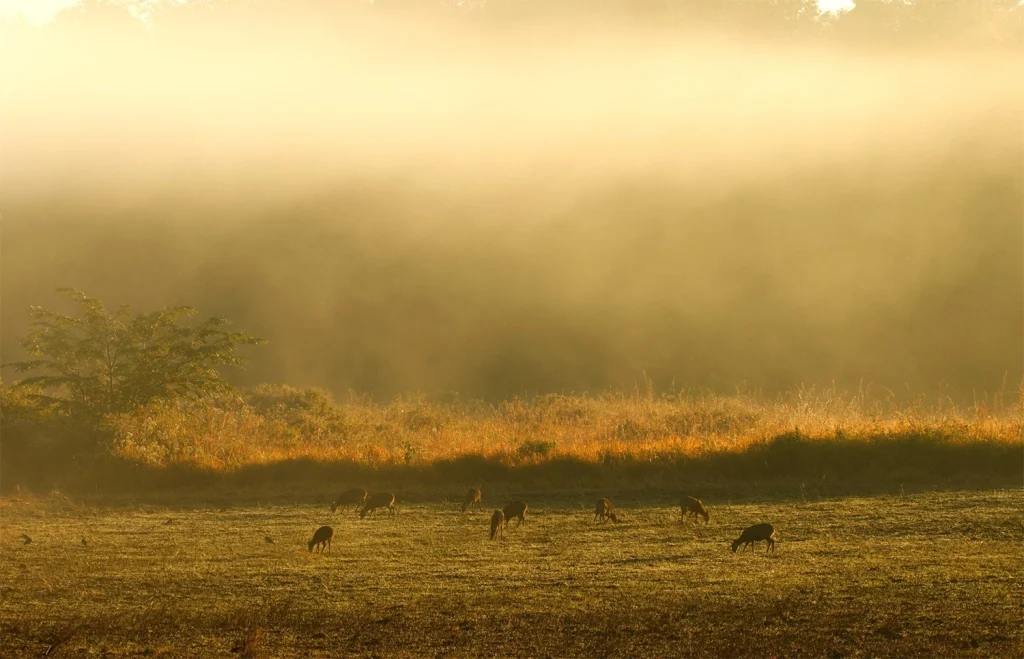
Soon, several animals are grazing across the meadow.
Wildlife is not an incidental part of Thung Kamang. It is central to the story of this landscape.
Under a conservation programme established with the patronage of Her Majesty Queen Sirikit The Queen Mother, native wildlife was returned to the sanctuary and its habitat protected. Releases in 1983 and 1992 included deer, mouse deer and native birds.
More than three decades later, the legacy of that work can be glimpsed on mornings like this.
Deer in the mist
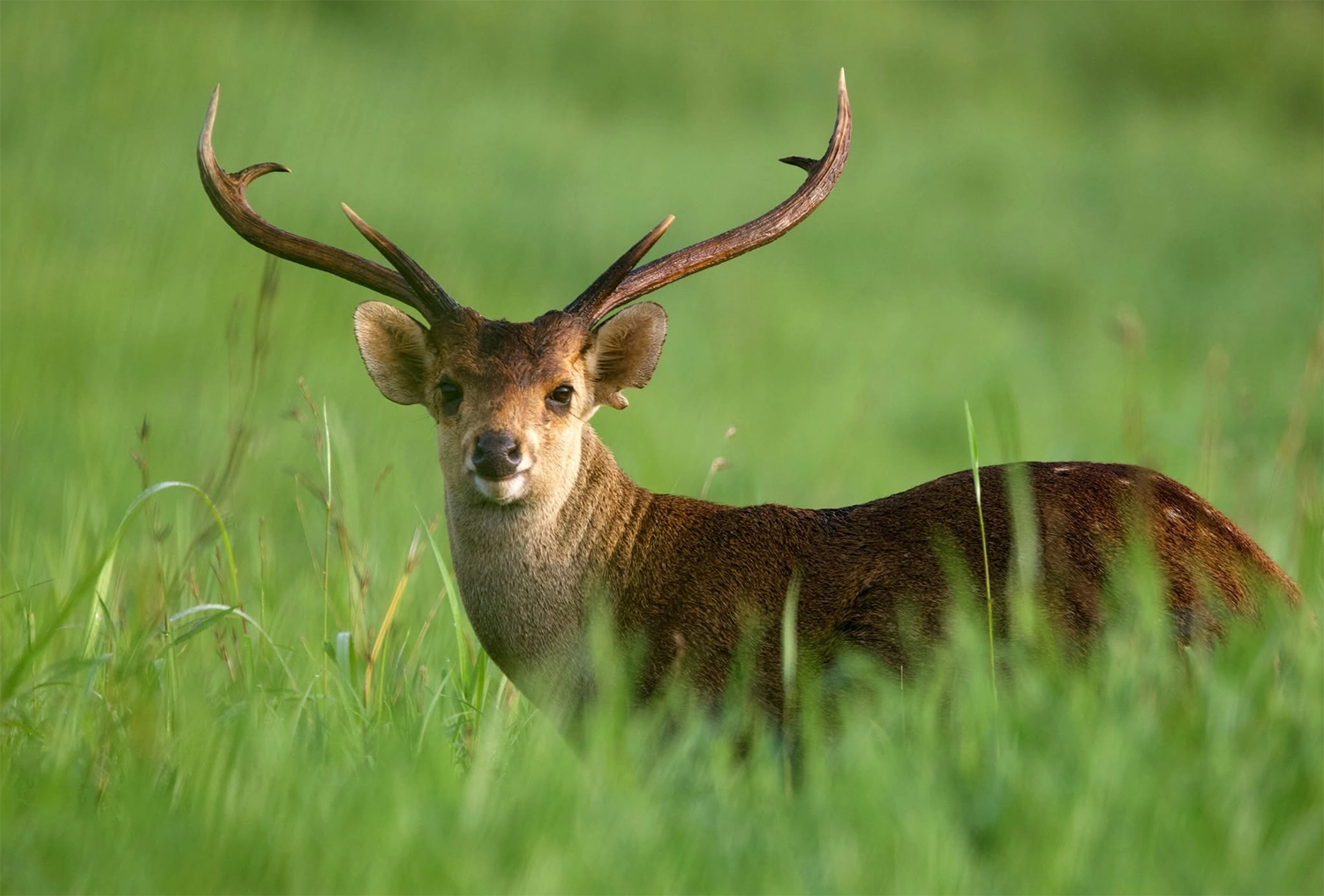
Among Thung Kamang’s most appealing residents are hog deer, animals well suited to this mixture of grassland and forest.
The males carry three-tined antlers, which are shed and regrown, while young fawns are born spotted, their white markings gradually disappearing as they mature. Rather than remaining deep in the forest, hog deer favour semi-open country, making Thung Kamang particularly good habitat.
Early morning is the time to look for them.
They graze quietly across the grass or near water, heads lowered until some almost imperceptible sound causes one animal to look up. A moment later, several others do the same.
Everything stops.
Then, apparently satisfied, they return to feeding.
If alarmed, however, the deer do not necessarily bolt together in a single herd. Individuals may scatter in different directions, disappearing remarkably quickly into grass and woodland.
One moment the meadow contains deer; the next, only grass is moving.
That sense of appearing and vanishing is part of Thung Kamang’s charm. Nothing performs on cue here.
Listening to the grassland
As the morning warms, the meadow grows noisier.
Egrets pick their way through wet ground and shallow pools. Birds call from the forest edge. Overhead, raptors begin to circle as rising warm air provides lift. During migration periods, other species pass through the sanctuary, attracting birdwatchers who arrive while the grass is still wet with dew.
Even without binoculars or an encyclopaedic knowledge of birds, there is plenty to hear: whistles from the trees, sudden wingbeats, insects humming close to the ground and the constant dry whisper of grass brushing against grass.
What you don’t hear is almost as important.
There are no lines of safari vehicles nosing across the meadow, and no loudspeaker announcing every animal that happens to appear. Thung Kamang rewards quieter behaviour.
Watch. Listen. Wait.
Eventually, the landscape starts giving things away.
The lone tree
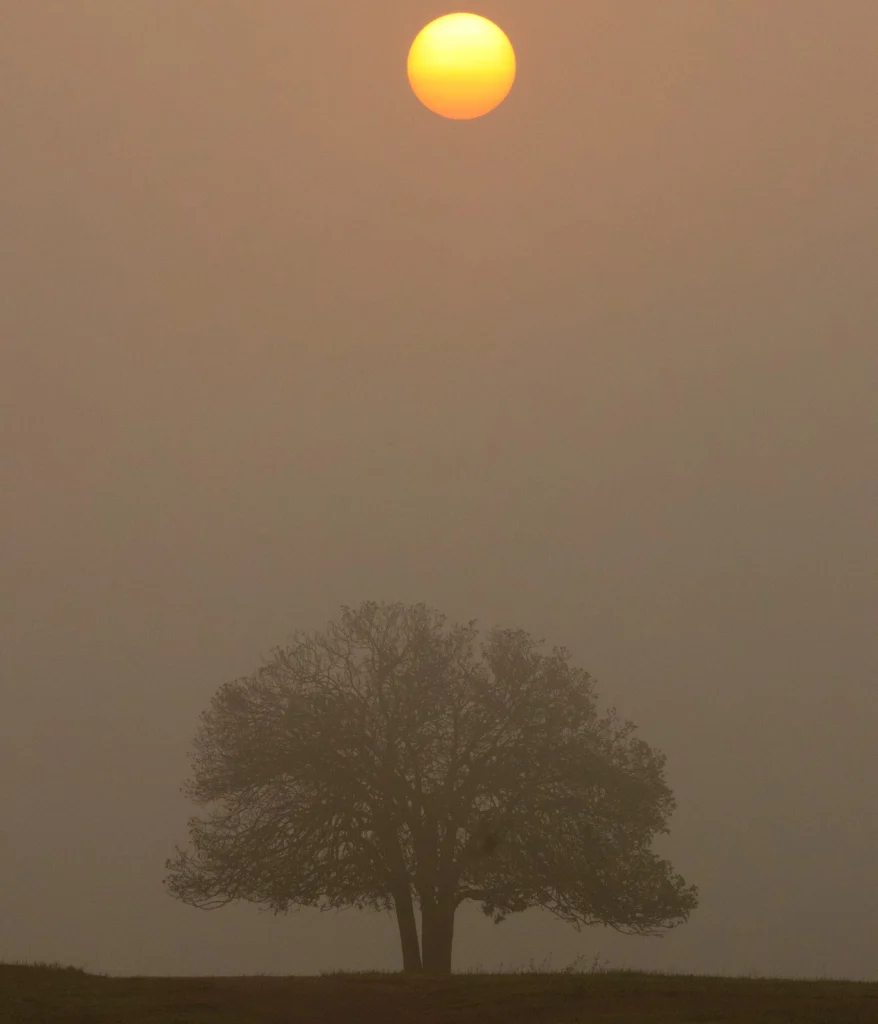
Near the heart of the grassland stands one of Thung Kamang’s most recognisable features: a solitary mueat tree.
A narrow track leads towards it across the meadow, drawing the eye straight into the landscape. Photographers return to it in different seasons and different weather. In early sunshine, the tree catches the warm light. At dusk it becomes a dark silhouette. On misty mornings, its trunk and branches can appear to float in a sea of white.
Yet the tree is more than a convenient photograph. Standing alone in such an open space, it gives the meadow scale.
Beyond it rise the forested hills of the wider Phu Khieo landscape. From viewpoints such as Pang Muang, ridge after ridge fades into shades of green and blue. On exceptionally clear days, the distant form of Phu Kradueng can be picked out on the horizon.
The view is a reminder that Thung Kamang is not an isolated patch of attractive countryside. It belongs to a much larger forest ecosystem.

THAILAND FESTIVAL
Tomorrowland Goes Thai
Thailand brought a splash of its food, culture and hospitality to Tomorrowland Belgium as anticipation builds for the music festival’s first Asian edition near Pattaya this December.
>> Read more
A landscape restored
Perhaps that is why the meadow feels so different from many of Thailand’s better-known natural attractions.
There is no enormous waterfall at the end of the path, no dizzying cliff and no single viewpoint demanding to be photographed. Thung Kamang’s pleasures are smaller and slower.
They are found in the beads of dew caught on a grass stem; in fog moving almost imperceptibly across the basin; in the silhouette of an egret crossing the pale morning sky; and, most memorably, in the moment when a deer steps out of the forest and pauses before entering the meadow.
The landscape also tells a conservation story.
Grass provides food and shelter. Deer graze it. Streams bring water through the basin. Forest encloses the open ground and offers refuge. Human management, meanwhile, has helped restore wildlife and protect the habitat on which it depends.
None of this is particularly dramatic when viewed moment by moment. That is precisely the point.
The reward comes from seeing the pieces working together.
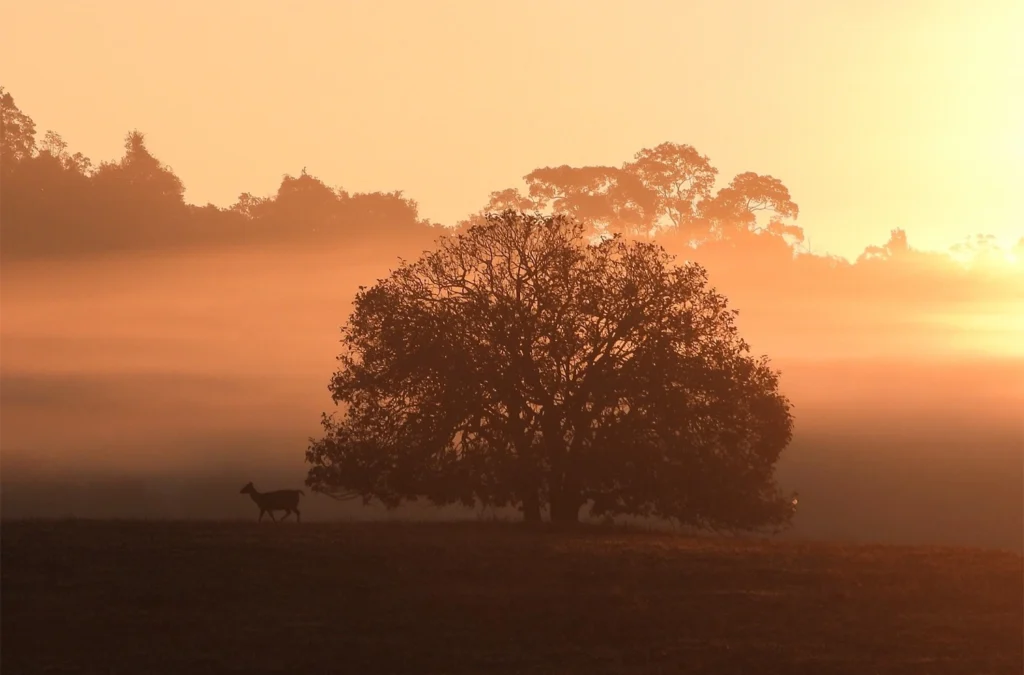
By mid-morning, the transformation is complete. The mist has burned away and sunlight lies across the entire basin. Birds are easier to see but the deer are becoming harder to find, gradually retreating towards the shade of the forest.
Soon the meadow appears almost empty.
Standing at its edge, it is tempting to wonder whether those first shapes in the mist were ever there at all.
Then the wind passes across Thung Kamang and thousands of grass stems bend together, sending a ripple from one side of the basin to the other.
The deer have disappeared.
The grassland carries on.







[…] >> Read more […]
Comments are closed.