
In the shadowed galleries of a Korean monastery museum, some of Thailand’s finest Buddhist treasures tell a story of faith, art and cultural exchange stretching across centuries and borders.
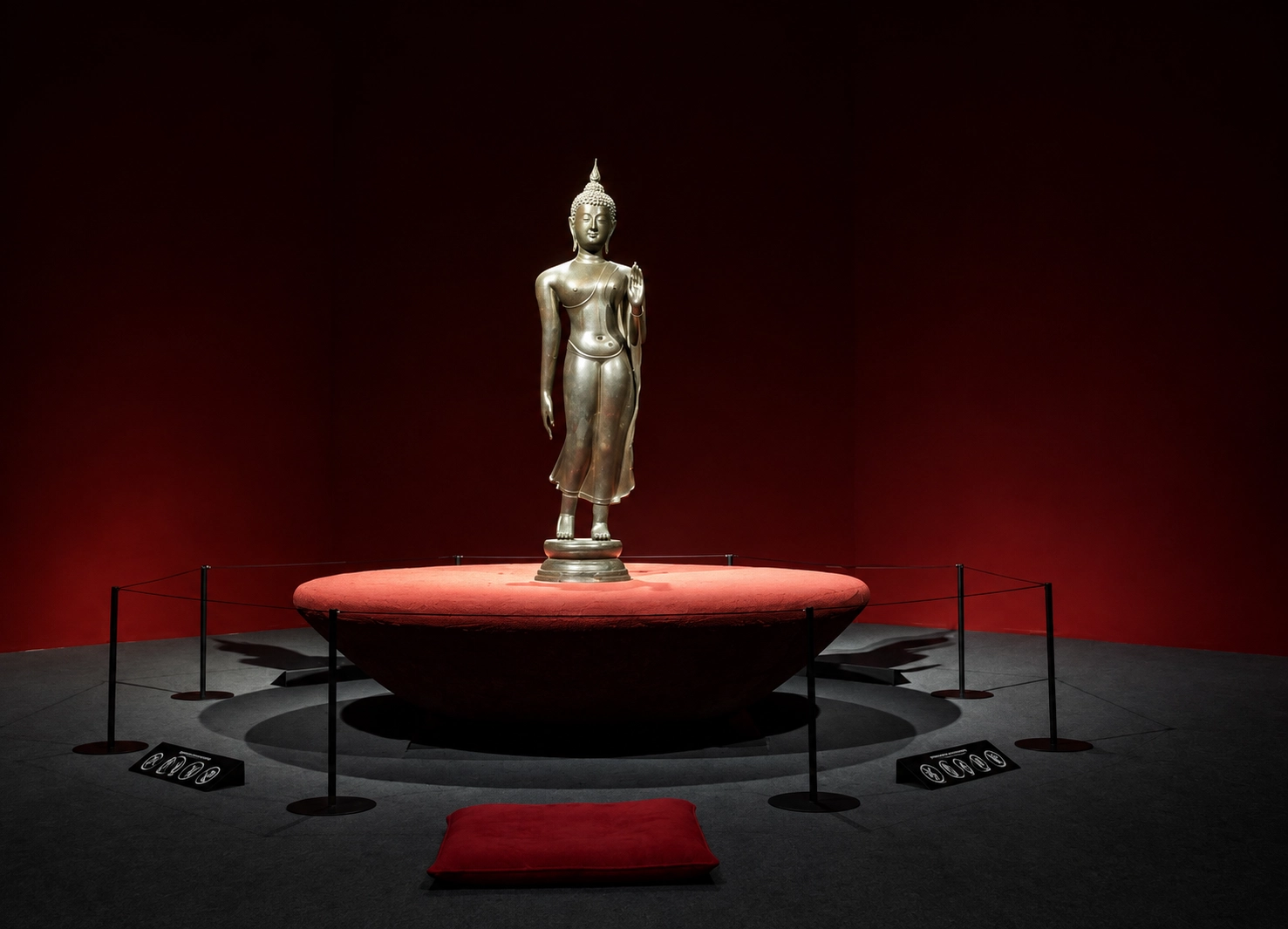
A solitary Buddha stands beneath a pool of light. One hand is raised, the other hangs loosely by his side, while the body seems caught in the middle of a step. Against the dark red walls of the gallery, the bronze figure appears almost weightless.
This is the walking Buddha of Sukhothai, one of the most recognisable forms in Thai Buddhist art — and here, thousands of kilometres from Thailand, it has found an unexpectedly fitting home.
The sculpture is among 55 objects gathered from 13 national museums across Thailand for Amazing Thailand: Thai Buddhist Art, on show at Tongdosa Museum in Yangsan, South Korea, from 3 October to 4 December 2026.
The exhibition spans centuries of Thai Buddhist art, but its setting makes the encounter particularly compelling. Tongdosa lies within one of South Korea’s great Buddhist monastic landscapes. Founded in the seventh century, the temple forms part of Sansa, Buddhist Mountain Monasteries in Korea, inscribed on UNESCO’s World Heritage List in 2018.
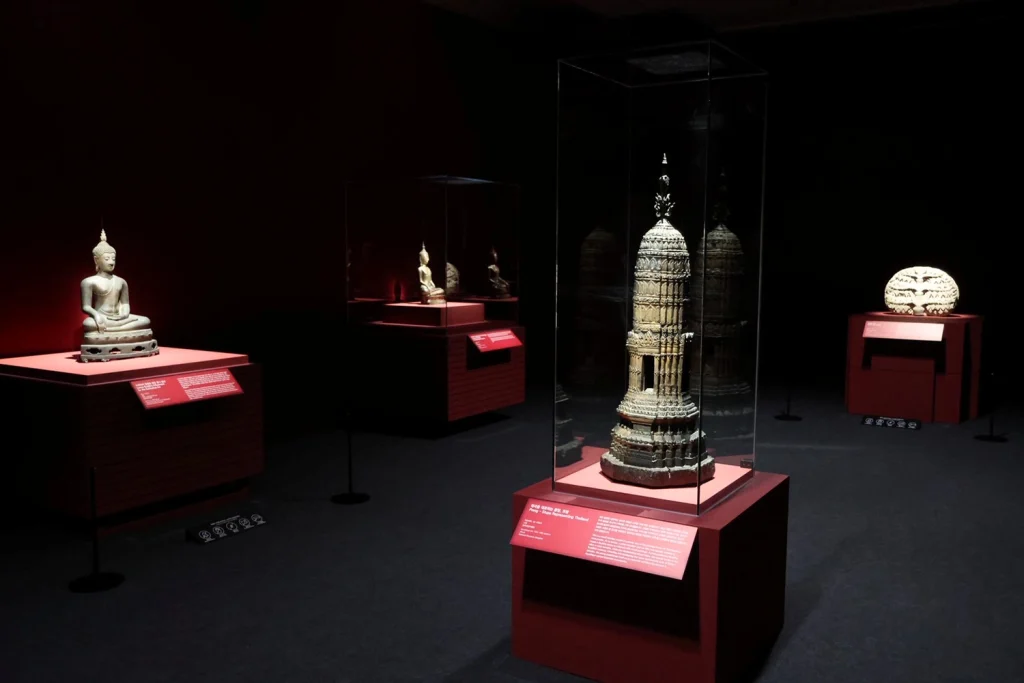
Here, Thai Buddhist objects are not simply travelling museum pieces. They have arrived within another living Buddhist tradition.
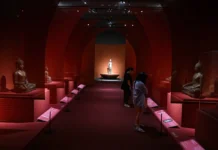
Inside the museum, the exhibition unfolds through darkened rooms illuminated by pools of warm light. Buddha images emerge from black and crimson backgrounds; manuscripts and votive objects occupy quieter corners. The restrained presentation encourages visitors to look slowly — at the tilt of a head, the curve of a robe or the intricate surface of a sacred object.
At its heart is the walking Buddha.
The image flourished during the Sukhothai period, generally regarded as one of the defining eras of Thai Buddhist sculpture. Unlike the seated Buddha familiar across much of Asia, this figure moves. The shoulders slope gently, the body curves almost rhythmically and the raised heel suggests the next step is about to follow.
It transforms bronze into movement.
Nearby objects reveal just how varied Thailand’s Buddhist visual culture became as different kingdoms and artistic centres developed across the country. A Lanna work depicting the Buddha placing his footprint speaks to northern Thailand’s traditions of pilgrimage and sacred geography. An illustrated Phra Malai manuscript from the Rattanakosin period moves into the narrative world of Buddhist cosmology, following the monk Phra Malai through heaven and hell and exploring ideas of merit, morality and rebirth.
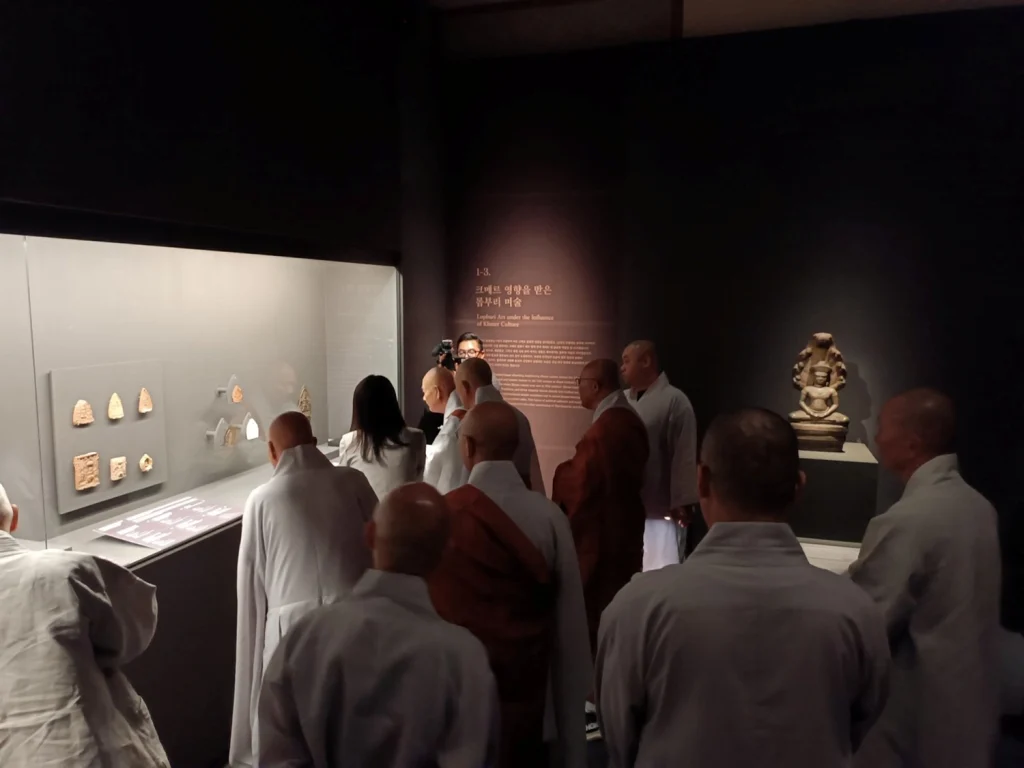
Together, the objects demonstrate that there is no single language of Thai Buddhist art. Sukhothai elegance, Lanna traditions and later Bangkok craftsmanship emerged from different places and historical circumstances, while remaining connected through Buddhist belief.
That story acquires another dimension at Tongdosa.
Thailand and Korea developed their Buddhist cultures far apart, shaped by different histories, artistic traditions and schools of Buddhism. Yet walking through the exhibition reveals recurring concerns: how to represent enlightenment, how sacred objects connect worshippers with teachings, and how beauty can become an expression of faith.
The exhibition also represents a continuing cultural exchange between Thailand’s Fine Arts Department and South Korea’s museum institutions. It follows an earlier presentation at the National Museum of Korea in Seoul and forms part of cooperation in museum practice, heritage conservation and knowledge exchange.
CHIANG MAI
Chiang Mai: The Art of Making at Sanggadee Space
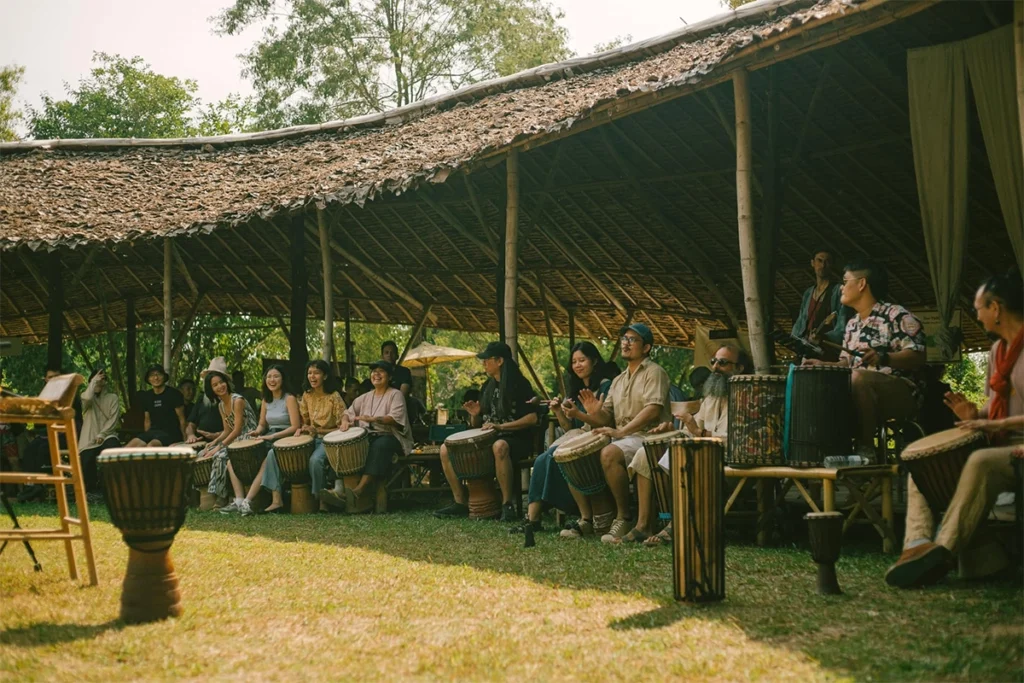
A short drive from Chiang Mai, Sanggadee Space is a creative sanctuary where traditional crafts, ecological thinking and community come together. More than a museum or market, this San Kamphaeng retreat offers a living showcase of northern Thailand’s creative spirit.
>> Read more
Yet the most memorable dialogue takes place silently.
In one gallery, the Sukhothai Buddha stands alone on a circular platform, surrounded by darkness. There is little to distract from the figure. Light catches the bronze face, the long arms and the flowing contours of the robe.
Created centuries ago in Thailand, the Buddha is now being viewed through Korean eyes.
For a moment, geography seems almost irrelevant. What remains is an image of a figure taking a step forward — and an artistic tradition that has travelled remarkably far without losing its sense of stillness.
ESSENTIALS
Amazing Thailand: Thai Buddhist Art
Tongdosa Museum, Yangsan, Gyeongsangnam-do, South Korea
3 October–4 December 2026